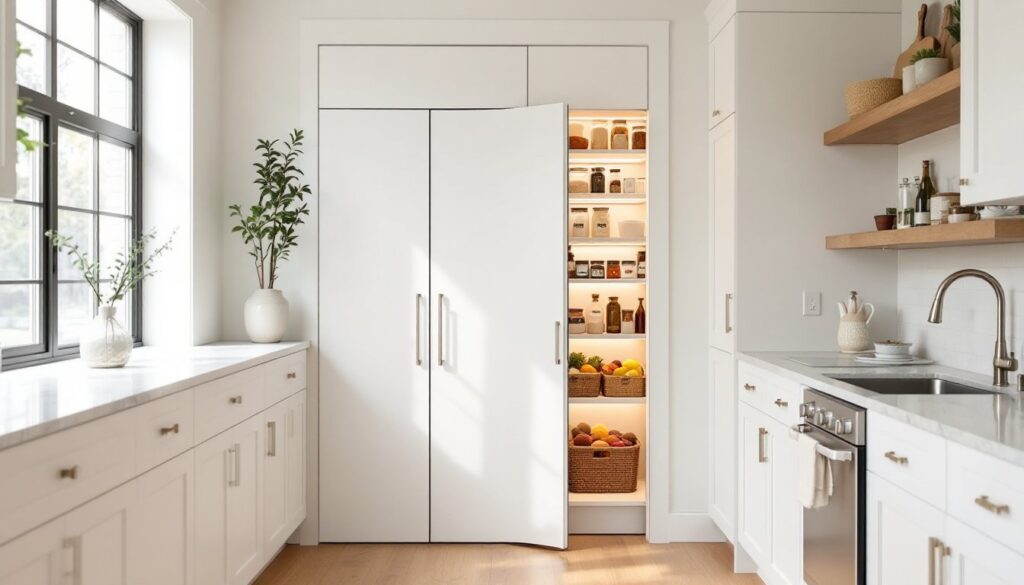
A walk-in pantry doesn’t need to announce itself to deliver serious storage. In small homes where square footage is at a premium, a hidden pantry blends seamlessly into existing architecture while organizing everything from bulk goods to small appliances. Concealing the entrance behind a clever door treatment or repurposing awkward nooks creates functional storage without sacrificing room flow or aesthetics. This approach works especially well in kitchens that can’t accommodate a traditional pantry footprint but still need dedicated space for dry goods, cookware, and meal prep supplies.
Table of Contents
ToggleKey Takeaways
- Hidden walk-in pantry ideas maximize storage in small homes without disrupting kitchen aesthetics or open floor plans.
- A 4×4 foot walk-in pantry can hold 3–4 times more than equivalent linear cabinet space, with room for 72+ linear feet of shelving at standard 8-foot ceilings.
- Flush-mount, pocket, and mirror-paneled doors are practical concealment strategies that blend seamlessly into your home’s existing architecture.
- Vertical shelving at 12–14 inch spacing, combined with pull-out drawers and LED task lighting, transforms compact pantries into efficient storage zones.
- Converting underused spaces like coat closets, under-stair cavities, and hallway alcoves into hidden pantries solves storage challenges without renovating your kitchen.
- Visibility and organization are critical: use clear containers, label everything, and arrange items by category to maximize accessibility in smaller spaces.
Why a Hidden Walk-In Pantry Is Perfect for Small Homes
Small homes typically sacrifice dedicated storage for open floor plans, but a hidden walk-in pantry reclaims that space without disrupting the layout. A concealed entrance maintains clean sight lines and prevents the pantry from visually cluttering adjacent living areas, important when the kitchen opens directly into dining or family rooms.
From a practical standpoint, walk-in pantries outperform standard cabinets in usable storage capacity. A closet-sized footprint (as small as 4 feet by 4 feet) can store 3–4 times more than equivalent linear cabinet footage because vertical walls and doorway depth all become functional surfaces. That’s enough room for 72+ linear feet of shelving if walls are built to standard 8-foot ceiling height with shelves spaced 12–14 inches apart.
Hiding the pantry also solves design challenges in period homes or rentals where adding visible built-ins would clash with existing trim, molding, or architectural details. A flush door treatment or integrated panel keeps the intervention reversible and visually neutral.
One structural consideration: if the pantry conversion involves removing or relocating walls, verify whether any are load-bearing. Non-bearing walls (typically interior partitions parallel to floor joists) can usually be modified with a standard building permit, but load-bearing walls require engineered headers and often a structural engineer’s stamp. When in doubt, consult a licensed contractor before cutting into framing.
Clever Concealment Strategies for Your Pantry Door
The simplest concealment method is a flush-mount door finished to match adjacent walls. Use a solid-core door (1¾ inches thick) for rigidity, hang it on ball-bearing hinges rated for 200+ pounds, and install the same baseboard, paint, or wallpaper across the door face. A push-latch mechanism eliminates visible hardware, though this requires a magnetic or mechanical catch that releases with light pressure.
For tighter spaces, a pocket door slides into a wall cavity and disappears entirely when open. Standard pocket door frames fit 2×4 stud walls (actual depth 3½ inches), but verify you have clearance in the wall cavity, no plumbing, electrical, or HVAC runs. Installation involves removing drywall, framing the pocket, and hanging a track system. Soft-close hardware prevents slamming.
Another approach is a mirror-paneled door that doubles as a full-length dressing mirror. This works well in hallways or near bedrooms where kitchen organizing strategies extend into adjacent spaces. Use ¼-inch mirror glass adhered to a solid backer with construction adhesive rated for vertical surfaces.
Bookshelf Doors and Panel-Matched Entries
A bookshelf door hinges on a concealed pivot and swings open to reveal the pantry behind it. This approach requires sturdy construction: build a ¾-inch plywood frame, attach fixed shelves (not adjustable), and mount the assembly on a commercial pivot hinge rated for 300+ pounds. The bottom pivot bears most of the weight, so it must anchor into the subfloor or a steel threshold plate, not just finish flooring.
Keep the bookshelf shallow (6–8 inches deep) to reduce swing radius and door weight. Load it with lightweight items or permanent decor rather than heavy hardcovers that stress the hinges. A magnetic latch at the top corner holds it closed.
Panel-matched doors use the same trim profile and finish as surrounding wainscoting or board-and-batten walls. Rout vertical grooves into a flat door slab with a ½-inch straight bit set to ⅜-inch depth, then apply matching paint or stain. The door effectively vanishes into the wall treatment.
Smart Shelving Solutions That Maximize Vertical Space
In a small walk-in pantry, every inch of wall height matters. Start shelving 18 inches above the finished floor to allow space for baskets or small appliances on the floor level, then run shelves all the way to the ceiling. For an 8-foot ceiling, that’s six to seven shelves at standard 12–14 inch spacing.
Use ¾-inch plywood or pre-finished melamine boards cut to fit wall-to-wall. Support each shelf with metal brackets rated for 100 pounds or install a cleat system: rip 1×2 lumber and screw horizontal cleats into studs at 16-inch intervals, then rest shelves on top. This method looks cleaner because hardware stays hidden behind the shelf edge.
Adjustable shelving offers more flexibility but requires drilling multiple holes for shelf pins. A 32mm spacing pattern (European cabinetmaking standard) allows ½-inch adjustments. Use a drill guide or pegboard template to keep holes aligned.
Deep shelves (more than 16 inches) waste space unless items are stored two rows deep, which hides back-row contents. Instead, stick to 12–14 inch depths and add pull-out drawers or slide-out trays for smaller items. Ball-bearing drawer slides rated for 75–100 pounds handle canned goods and jarred items without sagging.
For narrow pantries (under 4 feet wide), consider wrapping shelves in an L- or U-shape to maximize perimeter storage. Leave a 24–30 inch aisle for comfortable access, anything narrower feels cramped and limits reach.
Lighting and Accessibility Features for Compact Pantries
A windowless pantry needs task lighting to prevent the back corners from becoming black holes. LED strip lights mounted under each shelf illuminate contents without adding heat or draining energy. Choose strips with 3000K color temperature (warm white) for accurate color rendering, useful when checking expiration dates or matching ingredients.
Run the strips on a single switch near the door or install a motion sensor that activates when someone enters. Motion sensors eliminate fumbling for switches with full hands. For hardwired installations, this requires running 14/2 Romex from an existing circuit to a junction box inside the pantry, work that typically requires a permit and may call for a licensed electrician depending on local codes.
Battery-powered puck lights or wireless LED strips work for renters or DIYers avoiding electrical work. Stick-on models last 30,000+ hours and run on AA batteries, though brightness fades as batteries drain.
Accessibility means bringing high shelves within reach. A small folding step stool stores flat against the wall when not in use. Alternatively, mount a pull-down shelf system, similar to those used in upper kitchen cabinets, that brings top-shelf items down to eye level. These systems use a spring-assist arm and cost around $150–$300 depending on load capacity.
Ventilation prevents mustiness in enclosed pantries. If the space lacks airflow, install a louvered door or cut a 4-inch vent near the floor and ceiling to create passive circulation. Use mesh screening behind vents to keep pests out.
Organizational Systems That Keep Everything Visible
The key to small pantry storage is visibility, if you can’t see it, you won’t use it. Clear acrylic or glass containers turn bulk goods like flour, rice, and pasta into visual inventory. Square or rectangular containers stack more efficiently than round ones and waste less shelf space.
Label everything, even if the contents seem obvious. Use a label maker for uniform text or chalkboard labels for flexibility. Include purchase or expiration dates on perishables to rotate stock effectively.
Group items by category: baking supplies together, canned goods together, snacks together. Within each category, arrange by height, tallest items in back, shortest in front, to maintain sight lines. Lazy Susans work well for corner shelves or deep alcoves where reaching the back is awkward. Choose models with raised edges to prevent items from sliding off during rotation.
Door-mounted racks add shallow storage for spices, wraps, or small packets. Use over-the-door organizers with multiple pockets or install a custom rack with 1×3 rails spaced to hold standard spice jars. Make sure the door is solid-core and hinges are upgraded to handle the added weight, standard residential hinges may sag under a loaded door rack.
Basket systems on lower shelves corral loose items like snack bars, seasoning packets, or root vegetables. Wire baskets allow airflow for produce: woven baskets suit dry goods. Pull-out wire baskets mounted on drawer slides offer easier access than fixed baskets.
Converting Awkward Spaces Into Hidden Pantry Zones
Underused spaces often hide in plain sight. A coat closet near the kitchen may serve better as a pantry, especially if there’s a secondary closet for outerwear. Remove the existing shelf and rod, then build floor-to-ceiling shelving using the methods described earlier. If the closet has bi-fold doors, replace them with a single flush door for a cleaner look.
Under-stair cavities offer surprising storage volume, though sloped ceilings require custom shelving. Measure the headroom at multiple points and cut shelves to fit the angled ceiling line. A miter saw handles the angled cuts more accurately than a circular saw. Frame out a doorway in the exposed side and hang a concealed door.
Bump-outs or alcoves between rooms sometimes result from plumbing chases or structural columns. If the space is at least 24 inches deep and 36 inches wide, it’s pantry-worthy. Install a narrow door (or pocket door if width is tight) and line the interior with shelves.
Hallway dead-ends or awkward corners near the kitchen can be framed into shallow pantries. Even a 12-inch deep space works for single-row storage of canned goods, spices, or boxed items. Use 2×3 lumber (actual size 1½×2½ inches) to frame the walls if space is tight, it’s strong enough for non-structural partitions and saves an inch per wall versus standard 2×4 framing.
When converting non-traditional spaces, check for mechanical systems hidden in walls or ceilings. HVAC ducts, water supply lines, and electrical panels can’t be blocked or made inaccessible. Consult building plans or hire a home inspector to locate hidden infrastructure before cutting into walls.