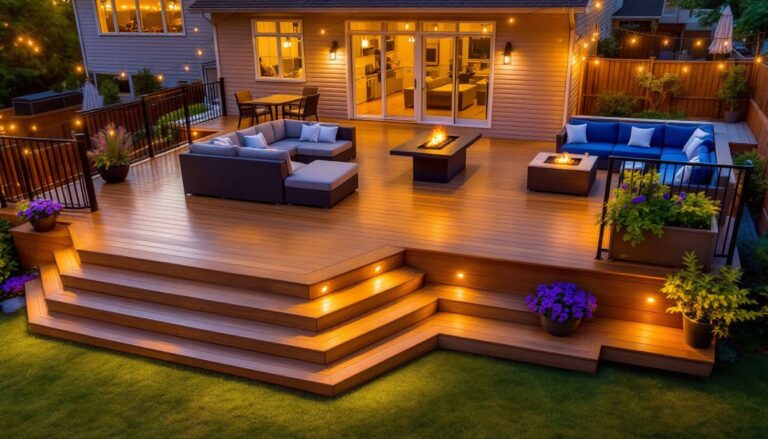
A well-lit deck extends usable outdoor hours, boosts safety, and adds curb appeal, but only if the lighting works with the space instead of fighting it. Too many homeowners slap up a single floodlight and call it done, leaving dark stair treads and shadowy corners that feel unwelcoming after sunset. Smart deck lighting balances function and atmosphere, using layers of light at different heights and intensities. Whether upgrading an existing deck or wiring a new build, the right fixtures make evening gatherings safer and more inviting without breaking the budget or requiring an electrician for every installation.
Table of Contents
ToggleKey Takeaways
- Layered deck lights using recessed fixtures, post caps, and stair lighting create both safety and ambiance, balancing function with aesthetic appeal.
- LED fixtures consume 75% less power than incandescent bulbs and last 25,000–50,000 hours, making them ideal for hard-to-reach deck light installations.
- Low-voltage systems (12V or 24V) are safer around wood and moisture, often require no permits for DIY installation, and deliver consistent brightness compared to solar alternatives.
- Recessed deck lights spaced every 6–8 feet along edges and stair risers prevent dark spots and trip hazards while maintaining a modern, sleek appearance.
- String lights and festoon bulbs offer flexible, temporary ambiance for renters or homeowners testing layouts, but require GFCI protection and shouldn’t exceed two sets per circuit.
- Under-rail and stair lighting with 20–30 lumens per fixture significantly reduces missteps and liability on high-risk zones without overwhelming glare.
Why Deck Lighting Matters for Your Outdoor Space
Deck lighting isn’t just about visibility, it’s a code-friendly upgrade that reduces trip hazards and liability while expanding the deck’s functional hours. The International Residential Code (IRC) doesn’t mandate deck lighting in most jurisdictions, but it does require guardrails and handrails to meet specific height and spacing standards. Proper lighting highlights these safety features, especially on stairs where shadows can obscure tread edges.
From a design standpoint, lighting defines zones. Ambient fixtures create overall illumination, task lighting targets cooking or dining areas, and accent lighting highlights planters or architectural details. This layered approach prevents harsh, flat lighting that washes out the space. A deck with only overhead fixtures feels like a parking lot: one with recessed step lights, post caps, and under-rail strips feels intentional.
Energy efficiency matters, too. LED fixtures draw 75% less power than incandescent bulbs and last 25,000–50,000 hours, reducing maintenance on hard-to-reach installations. Low-voltage systems (12V or 24V) are safer around wood and moisture, and they’re easier for DIYers to install since most jurisdictions don’t require permits for low-voltage outdoor lighting, though always check local codes before starting.
Recessed Deck Lights for a Sleek, Modern Look
Recessed deck lights mount flush with the deck surface or into stair risers, providing downward illumination without protruding hardware that snags feet or furniture. These fixtures work best in composite or PVC decking where drilling doesn’t compromise structural integrity. On wood decks, installers need to avoid joists and use waterproof housings to prevent rot.
Typical recessed puck lights measure 2–3 inches in diameter and require a hole saw for installation. Low-voltage models connect via daisy-chained wiring to a transformer, which steps down 120V household current to 12V or 24V. A 300-watt transformer supports roughly 20–25 LED puck lights, depending on wattage per fixture. Plan the transformer location near an outdoor-rated GFCI outlet, and bury the low-voltage cable at least 6 inches deep if running it under the deck.
For a modern effect, space recessed lights every 6–8 feet along deck edges or at each stair riser. Closer spacing creates runway-style lighting, which some homeowners prefer for high-traffic areas. Choose warm white (2700K–3000K) LEDs to avoid the sterile look of cool white bulbs. Some recessed fixtures include color-changing RGB options, but these often feel gimmicky unless the deck doubles as an entertainment space.
Post Cap and Railing Lights for Safety and Style
Post cap lights sit atop deck posts, casting 360-degree light downward to illuminate railings and adjacent deck surfaces. They’re one of the easiest deck light ideas to retrofit since most replace existing post caps without additional wiring if using solar models. For hardwired or low-voltage versions, run cable through the hollow core of composite posts or route it along the post exterior and conceal it with trim.
Standard 4×4 and 6×6 post caps are widely available in solar, low-voltage, and line-voltage formats. Solar caps work well for ambient lighting but may not provide enough lumens for task areas, expect 5–15 lumens per fixture compared to 50–100 lumens from hardwired LEDs. If the deck lacks direct sunlight for several hours daily, solar performance drops. In that case, low-voltage caps connected to a transformer deliver consistent brightness.
Railing lights mount horizontally along top or bottom rails, often using a track or clip system. Under-rail lighting strips are particularly effective, hiding the light source while washing the deck surface below. These strips come in rigid aluminum channels or flexible tape formats. Rigid channels offer better weatherproofing and heat dissipation, while tape is easier to route around corners. Both typically run on 12V or 24V DC and can be cut to length at marked intervals. Many outdoor enthusiasts pair these with woodland lighting design techniques to create a natural, layered effect.
Safety note: Always use fixtures rated for wet or damp locations (UL listing). Post caps in direct rain exposure need a wet-rated fixture: those under a roof overhang can use damp-rated models.
String Lights and Festoon Bulbs for Ambiance
String lights and festoon bulbs add overhead ambiance without permanent infrastructure, making them ideal for renters or homeowners testing layouts before committing to hardwired fixtures. Commercial-grade outdoor string lights use rubber-coated cable (SJTW) rated for wet locations, with sockets spaced 12–24 inches apart. Cheap holiday lights fade and crack within a season: invest in sets with impact-resistant bulbs and replaceable sockets.
Festoon lighting, globe-style Edison bulbs on a heavy-duty cable, has become the default for outdoor dining areas. The look is casual but polished, especially with vintage filament LED bulbs that mimic incandescent warmth at a fraction of the energy cost. Suspend the cable between posts, pergola beams, or exterior walls using screw-in hooks or eye bolts rated for the cable’s weight plus wind load. A 50-foot strand with fifteen 11-watt bulbs weighs roughly 5–7 pounds, so a ¼-inch stainless steel eye bolt into a 4×4 post provides adequate support.
For flexible layouts, use adjustable cable tensioners or turnbuckles at one end to take up slack. If stringing across spans longer than 15 feet, add an intermediate support to prevent sagging. Avoid draping cable across sharp roof edges or metal flashing that could abrade the insulation. Designers at Southern Living often recommend mixing string lights with task fixtures to balance mood lighting with functional brightness.
Power requirements: Most string light sets draw 100–200 watts total. Plug into a GFCI-protected outlet and avoid daisy-chaining more than two sets per circuit to prevent tripping breakers.
Solar-Powered Deck Lighting Solutions
Solar deck lights eliminate wiring and transformer costs, running on rechargeable batteries charged by photovoltaic panels. They’re best for accent and ambient applications where brightness isn’t critical, think post caps, step markers, and pathway borders. Solar technology has improved, but even high-quality units rarely exceed 20–30 lumens per fixture, compared to 100+ lumens from hardwired LEDs.
The panel’s placement determines performance. South-facing exposure (in the Northern Hemisphere) with 4–6 hours of direct sun yields the best runtime, typically 6–8 hours per night at full charge. Shade from roof overhangs, trees, or adjacent structures cuts output significantly. Some solar fixtures use remote panels connected by a low-voltage cable, allowing the panel to sit in full sun while the light mounts in shade. This setup adds flexibility but costs more.
Battery lifespan matters. Most solar lights use NiMH (nickel-metal hydride) or lithium-ion batteries. NiMH cells handle temperature swings better but hold less charge: lithium-ion delivers longer runtime but degrades faster in extreme heat or cold. Expect to replace batteries every 2–3 years, and choose models with accessible battery compartments to avoid discarding the entire fixture.
Solar isn’t ideal for primary deck lighting, plan it as supplementary illumination alongside hardwired or low-voltage fixtures. For DIYers exploring solar options, resources like Hunker provide seasonal maintenance tips to maximize panel efficiency and fixture longevity.
Under-Rail and Stair Lighting for Enhanced Visibility
Under-rail and stair lighting targets high-risk zones where shadows cause missteps. The IRC requires stair treads to be uniform in depth and risers uniform in height (with a maximum variance of ⅜ inch), but it doesn’t mandate lighting. That said, illuminating tread edges reduces liability and makes stairs usable after dark without fumbling for a flashlight.
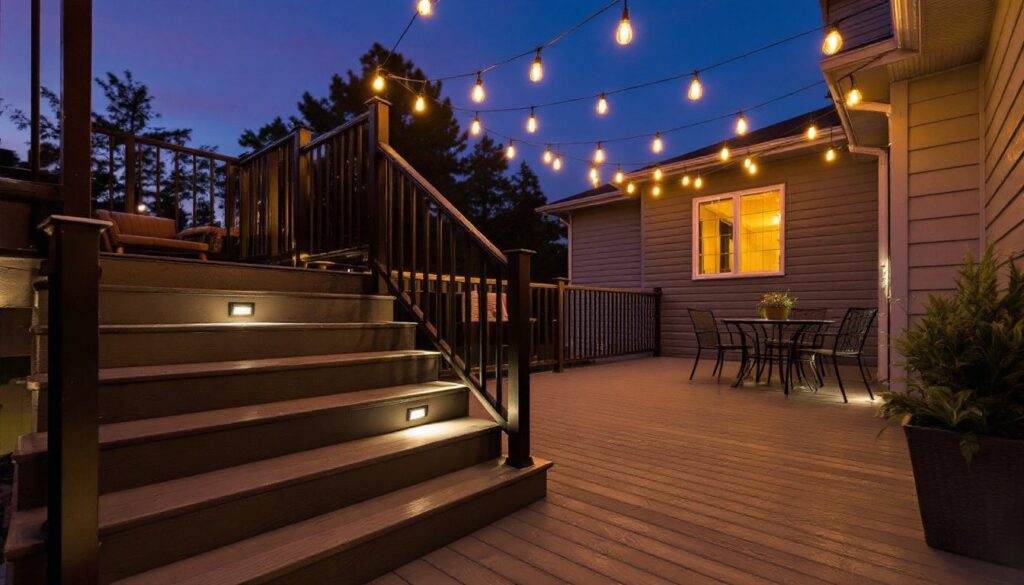
Recessed riser lights install into the vertical face of each step, shining downward onto the tread below. For a retrofit, measure the riser thickness, most composite risers are ¾ to 1 inch thick, requiring a shallow-profile fixture (often called a “paver light” or “wall light”). Drill a centered hole, feed the fixture’s wire through, and secure it with the included trim ring or flange. Wire each fixture in series back to the transformer, using 14-gauge or 16-gauge landscape wire rated for direct burial.
Alternatively, LED strip lighting can run along the underside of the tread nosing or beneath the bottom rail. Strips with silicone coating resist moisture better than bare PCB tape. Mount them in an aluminum channel for rigidity and better heat dissipation, excessive heat shortens LED lifespan. Use channel with a frosted diffuser to eliminate visible LED hotspots. Secure the channel with stainless steel screws or outdoor-rated adhesive, and seal ends with silicone caps to prevent water intrusion.
Stair lighting should provide enough contrast to define each step without glare. Aim for 20–30 lumens per riser light or a continuous strip with output around 100 lumens per foot. Dimming controls add versatility, letting users dial down brightness for late-night trips without blinding themselves. Home improvement enthusiasts often reference Gardenista for creative stair lighting layouts that blend function with garden aesthetics.
Wiring tip: When running cable under a deck, staple it to joist sides rather than the bottom to avoid accidental punctures from screws or nails driven up through decking.
Conclusion
Effective deck lighting combines recessed fixtures, post caps, string lights, and targeted stair illumination to layer function and ambiance. Start by addressing safety zones, stairs, level changes, and thresholds, then add accent lighting to highlight features and extend evening usability. Low-voltage systems offer the best balance of DIY-friendliness, safety, and performance, while solar units work well as supplementary accents where wiring isn’t practical. Plan the layout on paper, calculate transformer capacity, and test fixture placement with temporary lights before drilling or trenching. A well-lit deck pays off in safety, curb appeal, and more hours spent outdoors.